

I Survived the Modeling Industry. The Epstein Files Should Expose It.
I was a teenager when I met Jeffrey Epstein. I have an eerie, almost-cinematic memory of the encounter: us sitting poolside at what was presumably his Palm Beach home. Talking about the Dalton School, the New York City high school I graduated from, and where Epstein had been a math teacher. The sun on my skin.
I don’t remember much about how I got there. But I do know that an older model had invited me to meet “her friend Jeffery.” I know that I was in Florida for a modeling shoot, sent by my agency NEXT Model Management. And I know that my agency — and not the older model — had the home address Epstein used to send me a handwritten letter after our meeting, inviting me to take a writing class at The New School. “My treat,” he wrote. He signed it “J.E.”
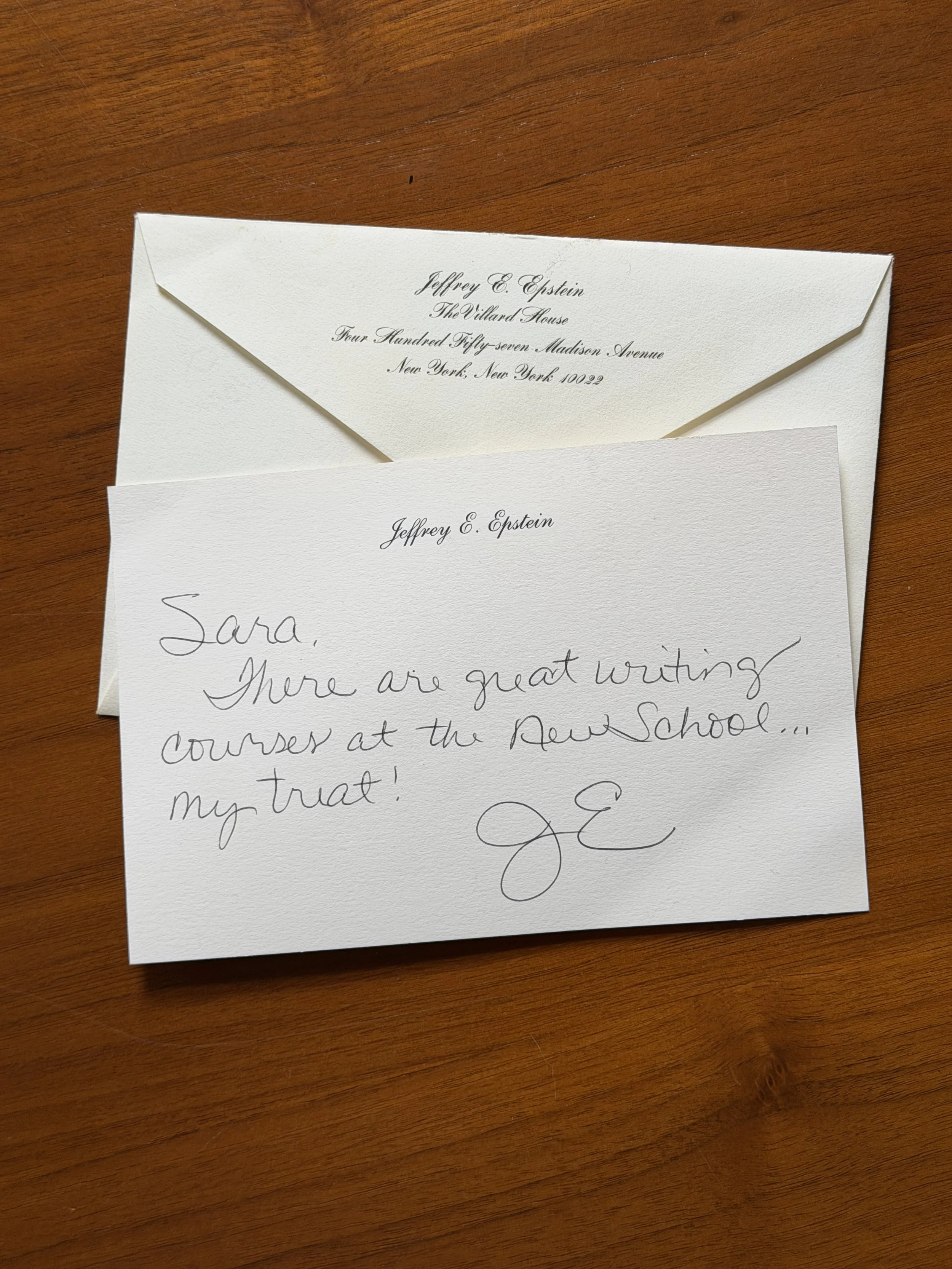
A handwritten letter Jeffrey Epstein sent to Sara Ziff just after her high school graduation in 2000.
I wasn’t aware of it at the time, but NEXT had a long and friendly relationship with Epstein. He regularly visited their New York offices, donated to the personal charities of Faith Kates, NEXT’s co-founder, and offered her multi-million dollar apartments and loans. In return, Kates regularly introduced him to young models in her care.
In 1992, Stacey Williams was introduced to Epstein at a dinner party hosted by Kates, and more than a decade later, Kates introduced Victoria’s Secret model Barbara Stoyanoff to Epstein. The relationship between Kates and Epstein didn’t end once he was convicted. In 2009, while Epstein was in prison, Faith Kates wrote to him: “unconditionally… will always be there for you.” In February of 2011, three years after Epstein was convicted, he emailed Faith Kates a list of three women. She responded: “I can get 2 that’s what you asked me for stand by.”
I was lucky. I was not sexually abused by Epstein — but I believe I was delivered to him. And I was far from the only one.
Despite its glamorous veneer, the modeling industry has long served as a pipeline that sends teenagers — sometimes as young as 14 — directly into the hands of abusers. Ever wonder why so many of Epstein’s victims were aspiring or working models? Or why so many of the most prolific predators of our era — Epstein, Bill Cosby, Michael Jeffries, Gerald Marie, Peter Nygard, Harvey Weinstein, Donald Trump — all had deep ties to the modeling industry?
It’s not coincidence. It’s infrastructure.
Young models are uniquely vulnerable. Historically, they have been forced to sign over power of attorney to their agencies, which means agencies are acting on behalf of the models to book jobs, cash checks, and deduct expenses — leaving them in the dark about their own business dealings. Usually, agencies are a model’s visa sponsor, landlord, and gatekeeper to opportunities, creating a power imbalance that has been disguised as the status quo, and leaving most models blind to the extortion and trafficking that so often takes place. Far too often, models are sent by their own agencies into the arms of known rapists.
Jean-Luc Brunel, the Parisian modeling agent and known sexual predator, trafficked over 1,000 girls and young women to Jeffrey Epstein. Underage models from Jean‑Luc Brunel’s MC2 agency—seeded with $1 million from Epstein—were placed in apartments owned by Epstein’s brother as they waited for work visas; in some cases, Epstein appears to have paid for the visas himself.
L Brands, the conglomerate behind Victoria’s Secret, knew for years that Jeffrey Epstein and Ghislaine Maxwell were posing as “recruiters” for lingerie modeling opportunities for girls as young as 14. Former CEO Les Wexner was reportedly alerted about this behavior, but it did not stop. Epstein survivor, Lisa Phillips, was signed by Ford Models after Epstein introduced her to then-CEO Katie Ford (Ford’s name and contact information also appeared in Epstein’s black book).
Phillips has gone on the record about Ford Models’ role in Epstein’s operation: “Ford Models had a lot to do with Jeffrey Epstein — with the exchange of girls back and forth.” Ramsey Elkholy and Daniel Siad (who faces allegations of rape in France) both acted as modeling scouts to recruit victims for Epstein and other abusers, including Gerald Marie and Jean Luc Brunel.
This pattern of abuse and agency facilitation is personal. At age 19, I was raped by Fabrizio Lombardo, a close associate of Harvey Weinstein’s, after I had been sent to Lombardo for a “go-see” by NEXT. Lombardo appears in a resurfaced photo of Donald Trump and Jeffrey Epstein, and even worked for a time out of Jean-Luc Brunel’s Paris apartment.
The industry wasn’t adjacent to this abuse. It was a central artery.
That’s why my organization, Model Alliance, is joining survivors to demand state and federal investigations into the modeling industry's role in Epstein’s abuse. We recently sent open letters—signed by more than 40 survivors and former models affected by industry abuse—to Letitia James and Representatives Thomas Massie and Ro Khanna. The letters compile evidence that agents introduced models to Epstein, map financial ties between him and prominent abusers in the industry, and document his longstanding relationships with modeling executives. Representative Khanna has referred the request to the House Oversight Committee. Whether it prompts a broader congressional inquiry—including hearings—may soon become clear.
In the meantime, we have made some progress on prevention. I’m proud that the Model Alliance championed and passed the Fashion Workers Act, which finally regulates modeling agencies and helps address the power imbalance that has long led to exploitation.
But accountability must extend beyond Jeffrey Epstein to the modeling industry that enabled him. This was never only about one—or even a handful—of bad actors. This is about an abusive system that has exploited the aspirations of so many young women and girls.
If we shed light on what’s broken, maybe together, we can fix it.